How to Find a Good Personal Trainer: 5 Questions to Ask Before You Sign Up
Liking your trainer matters more than their degree. An Allison Park coach with an M.S. and CSCS ranks the 5 questions to ask before you hire a personal trainer.
Most of us spend our days taking care of everyone else and pushing our own well-being to the back burner. So when you finally decide to invest in yourself and hire a coach, it's worth getting that decision right.
Finding the right personal trainer is an important decision, and it can really dictate the results you get. Here are the five things I'd ask before you sign up, ranked from most important to least.
Why the Right Trainer Changes Your Results
Before the list, a quick reason this matters so much.
In a 2000 study in Medicine & Science in Sports & Exercise, researchers gave two groups of men the exact same 12-week lifting program. One group trained with a personal trainer supervising them. The other group trained on their own. Same exercises, same plan.
The supervised group lifted heavier loads, increased those loads faster, and finished the 12 weeks with significantly more squat and bench press strength. The supervised group also added a significant amount of lean mass.
Same program, different results. The difference was the coach.
12 weeks
of identical programs. The group with a personal trainer lifted heavier and got significantly stronger than the group training alone.
Source: Mazzetti et al., Medicine & Science in Sports & Exercise, 2000
That's also why picking the wrong coach costs you more than money. So here's how to pick the right one.
1. Do You Actually Like This Person?
This is first, and it's the most important.
It does not matter if they check every other box on this list. If you don't like the person, it likely won't work out.
You are spending at minimum two or more hours per week with them. Often for months. Sometimes for years. So make sure you can actually be in their company.
Think about what happens when you don't like your trainer. You start finding reasons to cancel. You dread the session instead of looking forward to it. You stop showing up. And the most perfectly designed program in the world does nothing if you aren't there to do it.
How to check: You can't figure this out from a website or a phone call. Train with them once. Pay attention to whether they listen, whether they explain things in a way that makes sense to you, and whether you leave feeling better than you walked in.
2. Have They Helped Someone With Your Goal?
What is your goal?
Are you a runner looking to drastically improve your marathon time? A fighter looking to clean up your boxing form? Or are you just looking to live a better life, move without pain, and keep up with your kids or grandkids?
Those are very different jobs. It's really important that the coach you choose has proven expertise in the thing you're trying to do. I wouldn't go to a running coach if my objective was to deadlift 500 pounds.
If you're looking to lose weight, ask whether they provide nutrition support. Training alone rarely gets people there, and a coach who only covers the hour in the gym is only covering part of the problem.
Questions to ask:
- "What experience do you have with clients who want [your goal]?"
- "Can you tell me about someone you've helped get there?"
- "What does that usually take, and how long?"
A good coach will have real stories that sound like yours. A vague answer is an answer, too.
3. Have They Worked With Pain Like Yours?
This one is about real-world experience, and for most adults it's a big one.
Do you have chronic pain from that time you dislocated your shoulder wrestling a bear? Does your right knee hurt every time you go down the stairs? What about your back after sitting at a desk all day?
All of that pain is real. But we still need to get stronger. Exercise is one of the best-supported tools we have for chronic pain. A 2021 Cochrane review of 249 trials found moderate-certainty evidence that exercise therapy reduces chronic low back pain compared with no treatment or usual care.
249 trials
in one review found exercise therapy reduced chronic low back pain compared with no treatment or usual care
Source: Hayden et al., Cochrane Database of Systematic Reviews, 2021
Here's the catch. Lifting has the potential to make those daily pains worse if it isn't done properly. The right exercise, the right load and the right progression help. The wrong ones flare things up and make you quit.
So ask the coach directly: "Have you worked with someone with this specific pain before? What did you do?" We want to feel better, not worse.
If lower back pain is your main issue, I wrote a full guide on lower back pain from sitting all day that shows what a good approach looks like.
4. Do They Keep Up With Continuing Education?
This can get overshadowed by something like having a degree. In my opinion, it's more important.
Completing education courses every year, preferably in person, helps coaches stay current and adds more tools to the toolbox to help clients reach their goals. When something isn't working for you, a coach with more tools has more options.
It also shows they're interested and invested in the field and want to be a better coach for their clients.
For context, the NSCA requires certified coaches to earn 6.0 continuing education units every three years just to keep their certification. That's the minimum to stay certified. It's not a high bar, and a good coach clears it without thinking about it.
Question to ask: "What's the last course you took, and what did you change because of it?"
If they can't invest in themselves to provide a better service to you, why should you invest in them?
At Full Circle, our coaches complete continuing education every year, and the business pays for it. It's that important to us.
5. What Are Their Education and Certifications?
This one surprises people, because it's last on my list.
I think credentials can be important, but honestly, not as much as you'd expect. I have a master's degree in exercise science, and while it gave me a baseline in the theory and the tools I needed to earn my CSCS, most of what I use every day is what I learned actually working with people.
That came from my internship turned job at Next Level Spine and Sports Injury Center, the intern clinic at the Pittsburgh School of Massage Therapy, and then being out on my own. The more clients I worked with, and the more days I saw them, the more my skill set improved, and the better I got at applying what I learned in continuing education courses.
To be fair, the research does give credentials some credit. A 2002 study in the Journal of Strength and Conditioning Research tested 115 fitness professionals and found that a bachelor's degree in exercise science and an ACSM or NSCA certification were strong predictors of how much a trainer knew. Years of experience alone didn't predict knowledge.
So here's how I'd put it together:
- A reputable certification is the floor. Look for one from an organization with real requirements, like the NSCA or ACSM. The NSCA's CSCS, for example, requires a bachelor's degree to earn.
- Knowledge isn't the same as coaching. A test measures what a trainer knows. It doesn't measure whether they can read your body, adjust around your knee, or keep you coming back for a year. That part comes from reps with real people, which is exactly what questions 1 through 3 are checking.
The 5 Questions at a Glance
| Question to ask | A good answer sounds like | A red flag sounds like |
|---|---|---|
| Do I like working with this person? | You leave the first session feeling heard and better than you came in | You dread the next one |
| Have you helped someone with my goal? | Specific client stories that sound like yours | "I can train anybody for anything" |
| Have you worked with pain like mine? | "Yes, here's what we did, and here's what we'd avoid" | "Just push through it" |
| What continuing education have you done lately? | A recent course, and what they changed because of it | Nothing since they got certified |
| What are your certifications? | A reputable cert (NSCA, ACSM) plus hands-on experience | A weekend online cert and no experience |
How to Test a Trainer Before You Commit
Reading bios only gets you so far. The best way to answer all five questions is to train with the coach once.
In a single session you'll find out whether you like them, whether they asked about your goals and your pain before loading you up, and whether they explained why you were doing what you were doing.
While you're comparing, it's also worth knowing what you'll pay and what's included. I broke that down in how much a personal trainer costs in Pittsburgh, and the difference between private, semi-private and group training. And when someone quotes you a price, ask how long each session is. I explained why that matters in are 30 minute workouts enough to build muscle.
Want to see if you like us? Come train with us at our Allison Park studio for 2 weeks, free. That's plenty of time to answer all five of these questions before you spend a dollar.
The Bottom Line
This is a pretty good list to keep in mind when you're searching for a trainer. In order:
- Do you like them?
- Have they helped people with your goal?
- Have they worked with pain like yours?
- Do they keep learning?
- What are their credentials?
If you're in Allison Park, the North Hills, or anywhere around Pittsburgh and you want to see if you like us, give us a call or fill out the form for a free 2 weeks.
Always remember: the more willing you are to make changes to prioritize your well-being, the better you will be at taking care of those around you. YOUR well-being is important, and it is time to start prioritizing it, FOR LIFE.
Frequently Asked Questions
How do I find a good personal trainer?
Ask five questions, in this order of importance. Do you like the person? Have they helped people reach the specific goal you have? Have they worked with pain or injuries like yours? Do they keep up with continuing education every year? And what are their education and certifications? The best way to answer the first question is to train with them once before you commit.
What is the most important thing to look for in a personal trainer?
Whether you actually like them. You will spend at least two hours a week with this person, often for months or years. A trainer can have every credential on the list, but if you dread being in the same room with them, you will stop showing up, and a program you do not follow produces no results.
What questions should I ask a personal trainer before hiring them?
Ask what experience they have with your specific goal and whether they can share success stories from similar clients. Ask whether they have worked with the kind of pain or injury you have. Ask whether they provide nutrition support if weight loss is your goal. Ask what continuing education they completed in the last year. And ask what their certifications are and which organization issued them.
Do personal trainer certifications matter?
They matter as a floor, not a ceiling. A 2002 study in the Journal of Strength and Conditioning Research found that a bachelor's degree in exercise science and an ACSM or NSCA certification were strong predictors of a trainer's knowledge, while years of experience were not. But a knowledge test is not the same as coaching skill. The ability to read a client, adjust around pain and keep someone consistent is mostly learned by working with real people.
Can a personal trainer help with chronic back, knee or shoulder pain?
A trainer who has worked with your kind of pain can, and exercise is one of the best-supported treatments for chronic pain. A 2021 Cochrane review of 249 trials found exercise therapy reduced chronic low back pain compared with no treatment or usual care. But lifting done poorly can make daily pain worse, so ask any trainer directly whether they have worked with someone with your specific issue, and what they did.
How often should a personal trainer do continuing education?
Every year, ideally in person. The NSCA requires certified coaches to earn 6.0 continuing education units every three years just to keep their certification, so that is the minimum. Coaches who go beyond it are adding tools to help clients and showing they are invested in the work. If a trainer will not invest in getting better, it is fair to ask why you should invest in them.
Ready to train smarter?
Looking for a trainer you'll actually like working with? Try 2 weeks of personal training free at Full Circle Function & Fitness in Allison Park and see for yourself.
About the author
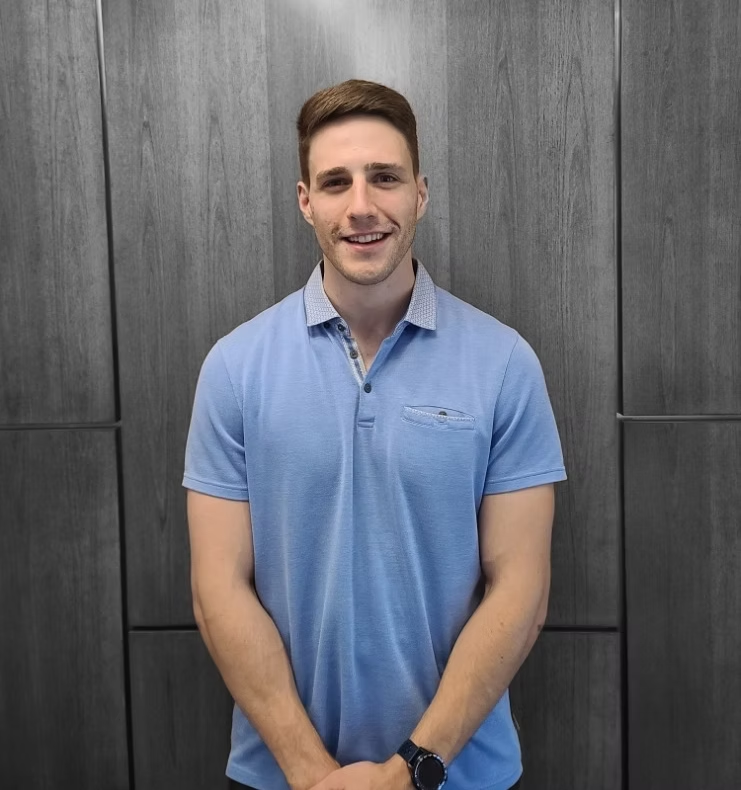
Cody Bock
Owner, Personal Trainer & Licensed Massage Therapist
M.S. Exercise Science · LMT (Licensed Massage Therapist)
Cody Bock is the founder of Full Circle Function & Fitness in Allison Park, PA. He combines a master's in exercise science with hands-on massage therapy expertise to help Pittsburgh's North Hills clients move better, train smarter, and recover faster.
Meet the teamRelated Reading

Are 30 Minute Workouts Enough to Build Muscle? An Honest Answer
In theory, yes. In real life, usually not. An Allison Park trainer explains who the 30-minute workout research was actually done on, and how much time you really need.
Read article
How to Build Muscle After 50: A Step-by-Step Guide
Yes, you can build muscle after 50. An Allison Park trainer lays out the 4 steps that work: sleep, lifting 3x a week to near failure, tracking protein, and consistency.
Read article
The Best Time of Day to Work Out for Weight Loss vs Muscle Gain
Morning or evening? A 2023 review of 14,000+ papers says timing barely matters. An Allison Park trainer explains what actually drives fat loss and muscle gain.
Read article