What to Eat Before a Morning Workout (Even If You're Not Hungry)
What to eat before a morning workout depends on your workout time. An Allison Park trainer breaks down early vs. mid-morning fueling and when to train fasted.
Each day, most of us live our lives prioritizing other people's needs and happiness while pushing our own well-being to the back burner. It's time to change things around. When you start prioritizing your own well-being, the well-being, happiness, and quality of life of those around you often improves right along with it.
Here's a question I get semi-regularly in lifestyle habit consults: what should I eat before a morning workout — especially when I'm not even hungry yet?
The answer is honestly pretty simple. There's really one major thing to consider.
The Only Question That Matters: What Time Is Your Workout?
That's it. That's the variable everything else hangs on.
A 6 AM workout and a 9 AM workout are two completely different fueling problems. One is about staying out of your own way. The other is about actually putting fuel in the tank. Let's take them one at a time.
What to Eat Before a 6 AM Workout
If your workout is at six, we most definitely want to prioritize sleeping over eating a big meal at 4 AM.
For a session this early, here's exactly what I do personally:
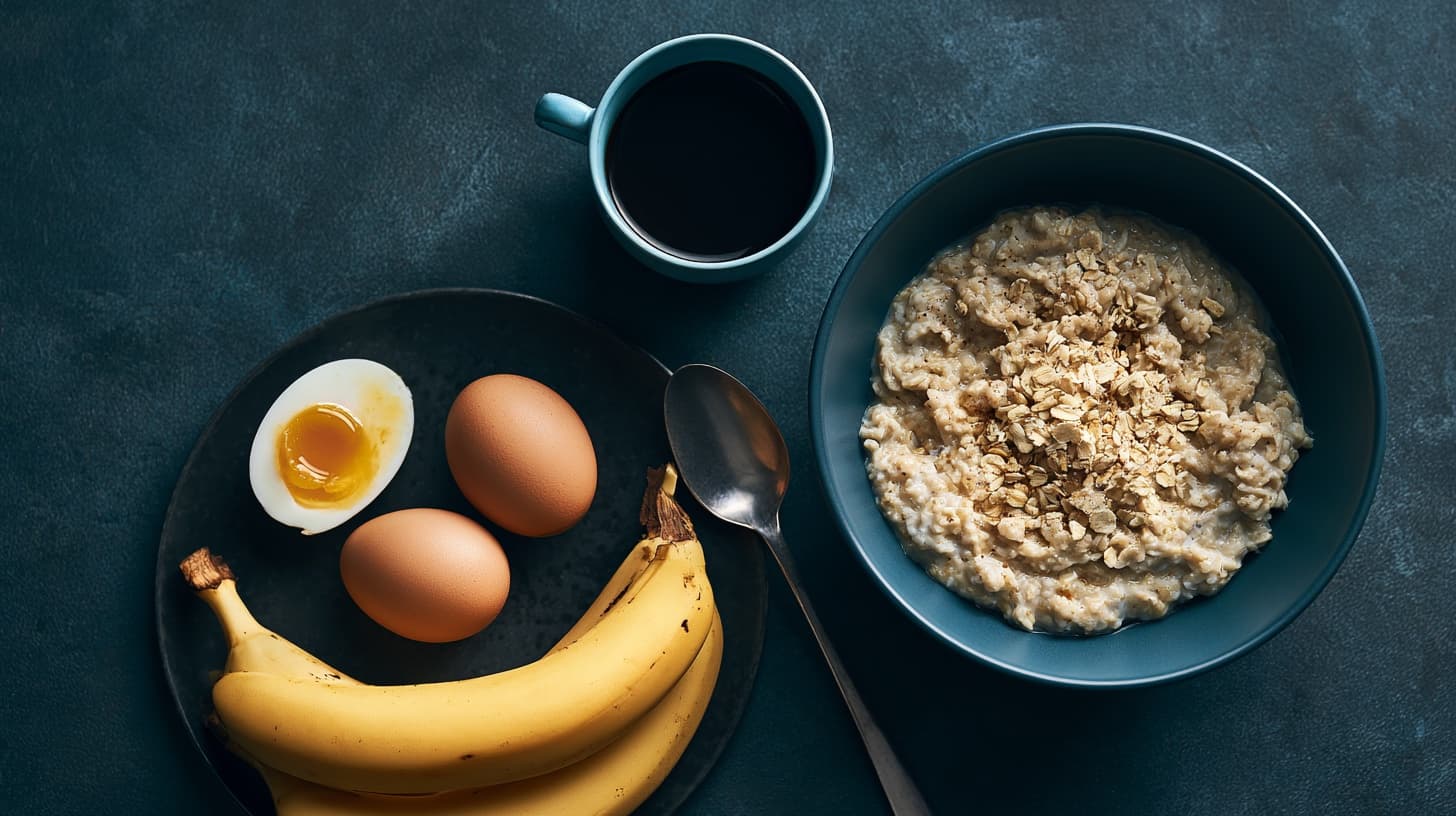
- A banana — about 30g of carbs, 120 calories
- A scoop of creatine
- A cup of coffee
I eat this around 5:15 or 5:30. It gives me fuel for the workout without forcing my body to digest a massive meal while I'm trying to train.
30g
carbs in a banana — fast, easy-to-digest fuel for an early workout
Source: USDA FoodData Central
Here's the part most people miss, though: for a 6 AM workout, what you had for dinner matters more than your banana. That evening meal is still fueling you. It's going to have a much bigger impact on your early session than anything you eat 30 minutes before. So if your morning workouts feel flat, look at dinner the night before — and while you're at it, look at how well you're sleeping, because that dinner-and-recovery window drives both.
On the creatine: monohydrate is the most studied sports supplement there is, and the International Society of Sports Nutrition calls it both safe and effective for exercise performance at 3 to 5 grams a day. The timing doesn't have to be pre-workout — I just take mine then out of habit. As always, check with your doctor before starting any supplement.
What to Eat Before a 9 AM Workout
Now it's mid-morning, and the math changes.
If you skip breakfast before a 9 AM workout, you're realistically not eating until 10:30 or 11. So the first question is: are you cool with that?
How does your body actually handle fasting — and specifically a fasted workout?
If it's fine and you can still get all your calories in across the day, then more power to ya. Fasted training is not bad or dangerous. It's a preference, and for some people it works great.
But if it's not fine — if you're the person who feels hungry at 9:30, which is mid-workout — that's no good. Hunger during training tanks your performance. In that case, we get up early and eat.
I'd say around 6:45 you want to be cooking breakfast:
- 2 or 3 eggs — 12 to 18g of protein, 10 to 15g of fat, 140 to 210 calories
- A bowl of oatmeal or a banana — around 30g of carbs, 120 to 180 calories
- A glass of water or coffee, plus some electrolytes (I like Thorne or LMNT)
12-18g
protein in 2-3 eggs — sustaining fuel that won't leave you bloated
Source: USDA FoodData Central
This breakfast gives you sustaining fuel and doesn't leave you bloated, gassy, or sleepy. Honestly? It's a great breakfast whether you're working out that morning or not.
If you want to get more precise than a blog post can — matching portions to your weight, your goals, and your actual schedule — that's the kind of thing we sort out in a lifestyle habit consult or personal training. The research backs the general shape of this too: carbohydrate availability before training supports performance for most quality sessions, but the right amount flexes with your goals.
Trying to dial in nutrition around your training instead of guessing? That's exactly what we work through at our Allison Park studio. A complimentary session is a good place to start.
The Simple Rule: Do You Have 2 Hours to Digest?
Strip away all the detail and it comes down to one clean rule.
If you have about 2 hours to digest, eat a full sustaining meal. If you don't, eat a banana or go fasted.
2 hrs
digestion window for a full pre-workout meal
Source: Cody Bock, LMT — Full Circle Function & Fitness
That's the decision tree. Everything above is just the detail underneath it.
Don't Overcomplicate It
I know this one's short and sweet. That's the point.
We don't always need to overcomplicate fitness and nutrition. Most people don't have a pre-workout meal problem — they have a consistency problem. Stick to the basics and BE CONSISTENT, and you're already ahead of almost everyone.
If you're in Allison Park, the North Hills, or anywhere around Pittsburgh and you want help building simple habits like this into a routine that actually sticks, come see us.
Always remember: the more willing you are to make changes to prioritize your well-being, the better you'll be at taking care of those around you. YOUR well-being is important, and it's time to start prioritizing it — FOR LIFE.
Happy to help.
Frequently Asked Questions
What should I eat before a morning workout?
It depends on your workout time. If you have about 2 hours to digest before you train, eat a full sustaining meal — eggs, oatmeal or a banana, and water with electrolytes. If you don't have 2 hours, keep it small: a banana and coffee, or train fasted if your body handles it well.
What should I eat before a 6am workout?
Keep it small so you are not digesting a big meal at 4am. A banana (about 30g of carbs), a scoop of creatine, and a cup of coffee around 5:15 to 5:30 is plenty. What you ate for dinner the night before matters more than your pre-workout snack for a session this early.
Should I work out fasted in the morning?
You can, if your body handles it and you still hit your total calories for the day. The test is simple: if you feel hungry mid-workout, fasted is not working for you and you should get up earlier to eat. If you feel fine and perform well, training fasted is completely okay.
Is a banana good before a workout?
Yes. A banana is around 30g of fast, easy-to-digest carbs and roughly 120 calories — enough fuel for an early workout without leaving you full or sluggish. It is one of the best options when you only have 30 to 45 minutes before you train.
What should I eat before a morning workout if I'm not hungry?
You do not need a big meal. Even if you are not hungry, a banana and coffee give you usable energy for an early session. If your workout is later in the morning and skipping breakfast leaves you hungry mid-workout, eat something small anyway — hunger during training hurts your performance.
How long before a workout should I eat?
About 2 hours is the sweet spot for a full meal — enough time to digest so you are not bloated or sluggish. If you have less than 2 hours, eat something small and carb-based like a banana, or train fasted. The closer to your workout you eat, the smaller the meal should be.
Ready to train smarter?
Nutrition doesn't have to be complicated — it has to be consistent. Book a complimentary session at Full Circle Function & Fitness in Allison Park and we'll help you build simple fueling and training habits around your real schedule.
About the author
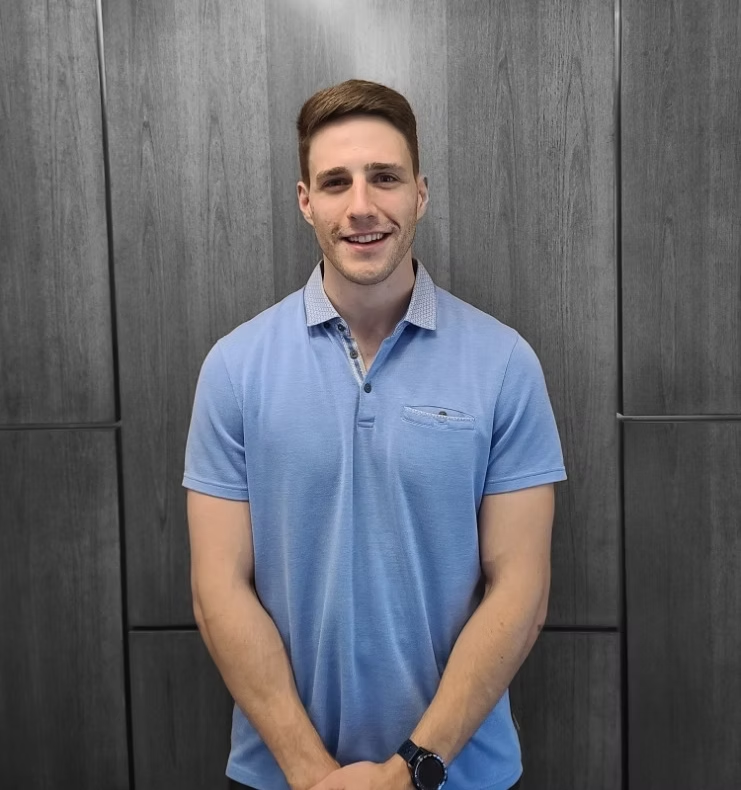
Cody Bock
Owner, Personal Trainer & Licensed Massage Therapist
M.S. Exercise Science · LMT (Licensed Massage Therapist)
Cody Bock is the founder of Full Circle Function & Fitness in Allison Park, PA. He combines a master's in exercise science with hands-on massage therapy expertise to help Pittsburgh's North Hills clients move better, train smarter, and recover faster.
Meet the teamRelated Reading
How Much Water Should You Drink a Day? A Trainer's Honest Answer
Most adults should aim for around 100 oz of water a day. An Allison Park trainer breaks down why hydration matters and easy tactics to actually drink enough.
Read article