How to Fix Tight Hips From Sitting: 4 Drills That Work in Under 10 Minutes
Tight hips from sitting? The chair is half the problem. An Allison Park trainer explains why weak glutes make tight hip flexors, plus a 10-minute video routine.
Each day, most of us live our lives prioritizing other people's needs and happiness while pushing our own well-being to the back burner. It's time to change that.
So your hips are tight. Let me guess: your back hurts too, and your hamstrings are probably tight.
Honestly, on paper, the fix is easy. It just takes some work on your end. But before we get to the fix, let's talk about why your hips are tight in the first place, because the obvious reason is only half the story.
Why Your Hips Get Tight From Sitting
Let's start with the obvious one: sitting all day.
When you sit, the muscles on the front of your hips get put into a shortened position. Those are your hip flexors: the psoas, the iliacus, and the top end of the rectus femoris, which is one of your quads. In a chair, all of them are slack, and they stay that way for hours.
Day in and day out, they "sort of" get stuck in that position until you do something about it, like get up and move.
This is not just gym-floor folklore. A 2021 study in Musculoskeletal Science and Practice measured passive hip extension in 144 adults using the modified Thomas Test, then sorted them by how much they sat and moved. The people who sat more than 7 hours a day and were physically inactive had about 6 degrees less hip extension than the active people who sat less than 4 hours a day. The researchers suggested that this looks like an actual adaptation in passive muscle stiffness, not just a feeling.
Six degrees might not sound like much. It is the difference between your hip opening up when you walk and your low back arching to make up for it.
6.1°
less passive hip extension in inactive adults who sit 7+ hours a day, compared with active adults who sit under 4 hours
Source: Boukabache et al., Musculoskeletal Science and Practice, 2021
The Less Obvious Reason: Weak Hips Make Tight Hips
Now the second reason. It's less obvious, but it's the more glaring issue: weakness.
When the muscles that surround the hip and pelvis are weak, the muscles on the front of the hip get tight to help stabilize. Your glutes are supposed to control your hips and pelvis. Your abs are supposed to keep your pelvis and rib cage stacked. When they aren't doing their job, the little muscles on the front of the hip take over.
When little muscles do a job they don't want to do, they get tight.
Read that same sentence again for your tight hamstrings. Same mechanism, different muscle.
The research backs this loop up from the other direction too. A 2015 study in the International Journal of Sports Physical Therapy compared athletes with clinically tight hip flexors to athletes with normal hip flexor length. During a squat, the tight-hip group showed significantly less gluteus maximus activation and relied more on their hamstrings. Tight hip flexors and under-working glutes go together. The authors called it reciprocal inhibition and synergistic dominance. I call it "your glutes are asleep and your hip flexors are doing overtime."
This is the part most people miss. If you only stretch, you're addressing half the problem. The tightness comes back because the weakness never left.
The Quick Fix: Get Up and Move Once an Hour
I know you've heard it before, and you still haven't done it.
It is, however, a quick little hip loosener. When you get your hips out of the position that is making them tight and you move, they start to loosen up. Walk to the printer. Take the stairs. Stand for a phone call. Do a few hip circles. Anything that puts your hips through a range of motion the chair doesn't.
Now, this is a very temporary solution. Literally just in the moment and for a short time after, your hips may feel a bit looser. Then you sit back down, and the clock starts over.
The long-term solution is loosening and strengthening the hips and abs, so the small muscles on the front of the hip can finally take a break.
The 10-Minute Tight Hips Routine (4 Drills)
So what do you actually do?
At home, with no trainer or coach supervising, and assuming you do not yet know how to squat and deadlift properly, you have a few options. This is the little 10-minute home routine I hand to desk workers to make that temporary relief stick a bit more.
Do the three exercises in this order, then finish with the fourth. Watch each video before your first set so you know what "right" looks like.
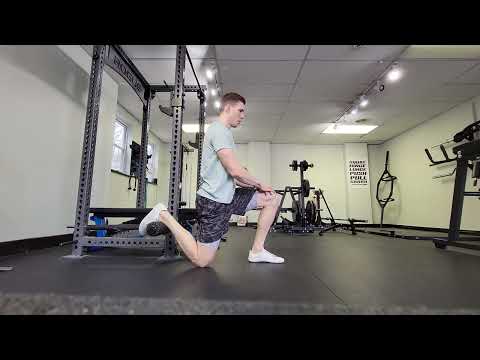
1. Half-Kneeling Quad and Hip Flexor Stretch
Do 3 sets of 30 seconds per side.
Set up with one knee on the floor and the other foot planted in front. The down-knee side is the side you're stretching.
The non-negotiable part: keep the glute of the down knee engaged the entire time.
That squeeze is not a detail. Activating the back side of your body (glutes) allows the front side (hip flexors) to relax. Trainer-speak for that is reciprocal inhibition. Normal-person translation: squeeze your butt so the front of your hip stops fighting you.
You should feel the stretch through the front of the hip and maybe into the upper quad. You should not feel it pinching in your low back. If you do, tuck your pelvis slightly, squeeze the glute harder, and make the position smaller.
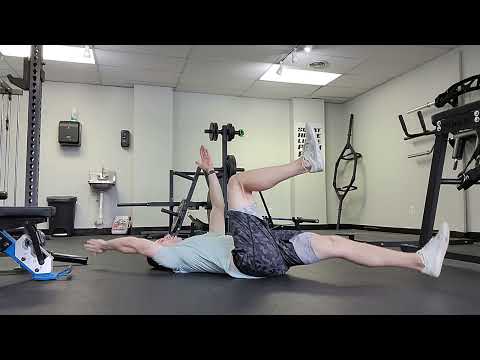
2. Dead Bugs
Do 3 sets of 10 reps per side.
Lie on your back with your arms pointed at the ceiling and your knees bent over your hips. Reach one arm overhead while extending the opposite leg, then come back and switch.
When you do these, the important part is keeping your low back flat on the ground. That is the whole exercise.
If you can't keep it flat, the version you're doing is too hard for right now. No ego, just modify. Try keeping your arms still, or bend your knees more to shorten the lever arm. Physics stuff: the farther your leg reaches, the harder your abs have to work to keep your pelvis from tipping.
You should feel your abs working when you do this. This is you teaching your core to control your pelvis, which is exactly the job the front of your hip has been covering.
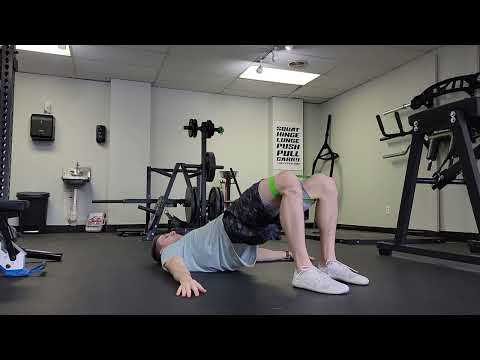
3. Glute Bridges
Do 3 sets of 12 reps, squeezing your glutes and holding the top position for 3 seconds each rep.
Lie on your back, knees bent, feet flat. Drive through your feet, squeeze your glutes, and lift your hips. At the top, hold and squeeze.
Back to that reciprocal inhibition thing again. This time it's actually loaded with your body weight. When you squeeze and hold the top portion of this movement, the hips get a nice stretch. It should feel super good.
A few troubleshooting cues:
- Feel your hamstrings? Move your feet closer to your butt.
- Feel your quads? Move your feet farther away from your butt.
- Feel your low back? Focus on keeping your abs engaged and moving from your glutes. If you can't get all the way up without getting into your low back, just go to the height you can reach without feeling it, and work to improve from there.
4. Then Go for a Walk
Don't skip this because it sounds too simple.
Walking takes your hips through repeated extension, the exact motion that sitting steals from you. It pumps blood through the area and reminds your body that moving from the hips is safe. Ten minutes around the block is plenty to start.
These three exercises and just under 10 minutes of time investment per day (a bit longer if you count the walk) can give some pretty awesome improvements in around 7 to 10 days.
Not because they're magic. Because you're finally giving the tight stuff a break and the weak stuff a job.
7–10 days
is when most people notice their hips loosening up with this routine done once a day
Source: Full Circle Function & Fitness, Allison Park PA
If your hips feel locked up and guarded before you even start, massage therapy at our Allison Park studio can calm the front of the hip down so the routine above actually works. Hands-on work gets you moving; the exercises make it stick.
Why Stretching Alone Won't Keep Your Hips Loose
Now, those exercises are going to look very "PT-ish." And while they are great exercises, they can only get you so far.
Here's the proof. A 2025 study in the International Journal of Sports Physical Therapy had healthy adults do a daily lunge-and-reach hip flexor stretch for six weeks. Hip flexor flexibility improved by about 6 degrees, which is a real win. But hip extension strength and gluteal endurance did not change at all.
Six weeks of daily stretching and the glutes were no stronger. If weakness is what's making your hips tight, and for most desk workers it is, stretching is a symptom treatment.
That's why you have to keep progressing the routine. Increase the load, the volume, and the intensity. Then increase the complexity of the movement. Bodyweight bridges become banded bridges, then hip thrusts. Dead bugs get longer levers and heavier arms. The half-kneeling stretch turns into a lunge, then a loaded split squat.
The Long-Term Fix: Relearn the Squat and Deadlift
The long-term solution to tight hips is building strength in the squat and deadlift.
"But my doctor told me not to squat or deadlift! It's bad for my back!"
Well, tell me, Mr. "I Can't Move": how do you plan on getting on and off the toilet? That's a squat. How do you plan on picking something up off the floor? That's a deadlift.
Your doctor is probably right. They might be bad for your back, right now, because you don't have the strength, movement efficiency, or ability to squat and deadlift well yet. That is a reason to learn, not a reason to avoid.
It is imperative that you re-learn how to do those movements. Notice I said re-learn. These movement patterns are foundational to living a normal life. A 10-month-old learns to squat and deadlift before they learn to walk. You are not learning something foreign. You are getting back something your body was built to do.
If these movements hurt your back, hips, or knees when you do them, that's information, not a verdict. It usually means the pattern needs to be rebuilt from a smaller version: a box squat, a kettlebell deadlift from blocks, a hinge drill with no weight at all. Start where you are and build.
If it's been years since you trained, how to start working out again after 40 walks through exactly how we rebuild those patterns over the first 16 weeks. And if your low back is the loudest complaint, I covered the back side of this same problem in lower back pain from sitting all day. And before you load either lift, warm up for it the way I laid out in pre-workout stretching: what actually helps vs what wastes time.
What to Do This Week
Here's the challenge for the next 7 days:
- Get up and move for a few minutes at least once an hour during the workday.
- Do the half-kneeling hip flexor stretch, dead bugs, and glute bridges once a day.
- Walk afterward, even if it's only around the block.
- Pay attention to what changes: how your hips feel when you stand up from your desk, how your hamstrings feel bending over, and how quickly things loosen up once you move.
Don't make it complicated. Complicated is where consistency goes to die. Close the laptop, get on the floor, do the work, go walk. Done.
The Bottom Line
Your hips are tight because they sit shortened all day and because the muscles that should be supporting them are too weak to do it. Getting up hourly is the temporary fix. The 10-minute routine makes it stick. Getting strong in the squat and deadlift makes it permanent.
If you're in Allison Park, the North Hills, or anywhere around Pittsburgh and your hips are still locked up after giving this a real week, call us to set up a free session. We'll show you how to squat and deadlift so they don't hurt.
Always remember: the more willing you are to make changes to prioritize your well-being, the better you will be at taking care of those around you. YOUR well-being is important, and it is time to start prioritizing it, FOR LIFE.
Frequently Asked Questions
Why are my hips so tight from sitting?
Two reasons. First, sitting parks your hip flexors (the psoas, iliacus, and the top of the rectus femoris) in a shortened position for hours, and a 2021 study of 144 adults found that people who sit more than 7 hours a day and move little had about 6 degrees less passive hip extension than active people who sit less. Second, and more important, when the glutes and abs around the pelvis are weak, the small muscles on the front of the hip tighten up to help stabilize. Tightness is often a weakness problem wearing a flexibility costume.
How long does it take to fix tight hips from sitting?
With the half-kneeling hip flexor stretch, dead bugs, glute bridges, and a daily walk, most people notice a real difference in about 7 to 10 days. That is the short-term win. Keeping your hips loose long term means progressing those drills and building strength in the squat and deadlift over the following months.
What is the best stretch for tight hip flexors?
The half-kneeling quad and hip flexor stretch, done 3 sets of 30 seconds per side with the glute of the down-knee side squeezed the whole time. The glute squeeze matters: activating the muscles on the back of the hip tells the muscles on the front to relax, a reflex called reciprocal inhibition. Without the squeeze you are mostly just leaning into your low back.
Why do glute bridges help tight hips?
A glute bridge loads the same reciprocal inhibition effect as the stretch, but with your body weight. When you squeeze your glutes and hold the top for 3 seconds, the front of the hip gets a stretch while the back of the hip learns to do its job. Research shows people with tight hip flexors use their glutes less during a squat, so waking the glutes up addresses the cause, not just the symptom.
Will stretching alone fix tight hips?
Usually not for good. A 2025 study in the International Journal of Sports Physical Therapy had adults do a daily lunge-and-reach hip flexor stretch for 6 weeks. Flexibility improved by about 6 degrees, but hip extension strength and glute endurance did not change. If weakness is what is making your hips tight, stretching treats the symptom. Strengthening the glutes and abs, then progressing to squats and deadlifts, treats the cause.
Are my tight hamstrings related to my tight hips?
Very often, yes. The same mechanism applies: when the big muscles around the pelvis are weak, smaller or secondary muscles get asked to stabilize, and muscles doing a job they do not want to do get tight. Tight hips, tight hamstrings, and a cranky low back usually show up together for exactly this reason, and they usually improve together when you strengthen the glutes and core.
Ready to train smarter?
Tired of stretching your hips every day just to have them tighten right back up? Book a complimentary personal training session at Full Circle Function & Fitness in Allison Park. We'll teach you to squat and deadlift without pain so your hips stay loose for good.

About the author
Cody Bock
Owner, Personal Trainer & Licensed Massage Therapist
M.S. Exercise Science · LMT (Licensed Massage Therapist)
Cody Bock is the founder of Full Circle Function & Fitness in Allison Park, PA. He combines a master's in exercise science with hands-on massage therapy expertise to help Pittsburgh's North Hills clients move better, train smarter, and recover faster.
Meet the teamRelated Reading

Pre-Workout Stretching: What Actually Helps vs What Wastes Time
Long static stretches can sap your strength before you lift. An Allison Park trainer shares the 4-part, 15-minute warm-up that actually works, with a sample squat day.
Read article
Lower Back Pain From Sitting All Day? Your Desk Job Might Be Contributing
Desk jobs can feed lower back pain by keeping your hips stiff and your core/glutes underused. An Allison Park trainer shares a 10-minute fix.
Read article