Pre-Workout Stretching: What Actually Helps vs What Wastes Time
Long static stretches can sap your strength before you lift. An Allison Park trainer shares the 4-part, 15-minute warm-up that actually works, with a sample squat day.

Each day, most of us live our lives prioritizing other people's needs and happiness while pushing our own well-being to the back burner. It's time to change things around. When you start prioritizing your own well-being, the well-being, happiness, and quality of life of those around you often improves as well.
The photo above: somewhere at the bottom of the Grand Canyon.
Your Workout Time Is Sacred. Don't Waste the First 15 Minutes
For a lot of people, the 60 minutes they get a few times per week is very sacred. It's scheduled carefully between taking the kids to activities, working all day, taking care of the house, and still trying to maintain a life.
So that sacred time needs to be efficient and effective. And it starts with the warm-up.
Unfortunately, most people waste their time during the warm-up. It really just comes down to not knowing what to do. You see other people doing some random stuff before they exercise and figure, "Well, it's better than nothing."
Let's talk about it.
What Wastes Time
1. Throwing random things together
A few arm circles, a hamstring stretch you remember from high school gym class, a couple of jumping jacks. Then you call it a warm-up.
This wastes time because a warm-up has to be done with intent and purpose. If it isn't preparing you for the specific work you're about to do, it's just a few extra minutes of standing around.
2. Long static stretching
Static stretching means getting into a stretch and holding it. Done before you lift, it can make you weaker.
How much weaker depends on how long you hold. In one study in the Journal of Applied Physiology, 33 minutes of stretching a single muscle cut its strength by 28 percent. It was still 9 percent weaker an hour later.
28%
drop in strength after a long bout of static stretching on one muscle, still down 9% an hour later
Source: Fowles et al., Journal of Applied Physiology, 2000
That is massive. If I only have two or three hours a week to exercise, I sure as hell don't want to be 30 percent less effective in that time.
To be fair, that study is the extreme end. Nobody stretches one calf for half an hour. But the effect shows up at normal doses too:
- A 2013 meta-analysis of 104 studies found pre-exercise static stretching lowered strength by about 5.4 percent on average. Its authors concluded static stretching should generally not be your whole warm-up.
- A 2016 review in Applied Physiology, Nutrition, and Metabolism found holds of 60 seconds or more per muscle cost about 4.6 percent, while holds under 60 seconds cost about 1.1 percent.
So a short stretch for a genuinely tight spot, followed by movement, isn't going to ruin your workout. Long holds as your entire warm-up will cost you, and they take time away from the things that actually help.
3. Doing nothing at all
Skipping the warm-up doesn't waste time on the clock. But your first few exercises won't be performed to the best of your ability.
And your first exercise is usually your most important one: the big lift of the day. So instead of spending the time in a warm-up, you've wasted it on your best set.
A 2010 systematic review in the Journal of Strength and Conditioning Research found that warming up improved performance in 79 percent of the measures studied, with little evidence that a proper warm-up does any harm.
79%
of performance measures improved after a proper warm-up, in a review of 32 high-quality studies
Source: Fradkin et al., Journal of Strength and Conditioning Research, 2010
What Actually Helps: Structure and Intent
The thing that makes a warm-up effective is structure and intent. If my workout of the day is built around a squat, then my warm-up is built around mobilizing, stabilizing, and priming the muscles involved in squatting.
Here's what goes into that structure.
Step 1: Soft tissue and dynamic mobility
Start by getting the tissue you're about to train ready to move.
Foam roll the area for about 60 seconds, moving slowly over a few different spots. Then add dynamic mobility. Dynamic means motion, and motion is lotion. That's how we get nice-feeling joints before we lift.
This might be one or two sets across a couple of exercises.
The research backs up keeping it short. A 2019 meta-analysis in Frontiers in Physiology found foam rolling before exercise slightly improved flexibility (about 4 percent) without hurting strength or jumping. The same 2016 review above found dynamic stretching improved performance by about 1.3 percent, where static stretching lowered it.
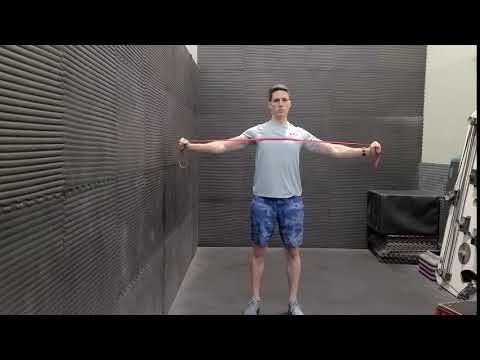
Step 2: Stabilize the joints you just mobilized
Next, wake up the muscles that hold those joints steady during your main lift.
On deadlift day, that might be hip thrusts. On push day, band pull-aparts for the upper back. The idea is to engage the muscles that will help stabilize the main lift of the day.
This is usually two or three exercises, about two sets each.
Step 3: Movement prep
Literally do the thing you're about to do, but lighter and easier.
Think: same pattern, easier movement. If you're squatting today, practice a squat pattern without the heavy bar first. You're grooving the movement so your first working set isn't also your first rep of the day.
Step 4: Prime the nervous system
Finally, get the muscles and nervous system ready to work hard by moving fast and powerfully.
Before squats, that might be a box jump. Before deadlifts, a kettlebell swing. Just a few sets of three to five reps. You're not trying to get tired. You're trying to get switched on.
All of this should take about 15 minutes, give or take.
Example: A 15-Minute Squat Warm-Up
Here's what that looks like on a squat day at our studio:
| Phase | Exercise | Sets x reps |
|---|---|---|
| 1. Soft tissue | Foam roll quads, moving slowly over a few spots | 60 sec each side |
| 1. Dynamic mobility | Alternating wide stance toe touch | 2 x 8 each side |
| 2. Stability | Side plank hip thrust | 2 x 8 each side |
| 3. Movement prep | Transverse squat (paired with hip thrust) | 2 x 10 |
| 3. Movement prep | Hip thrust (paired with transverse squat) | 2 x 10 |
| 4. Priming | Box jump | 2 x 3 |
The transverse squat and hip thrust are done as a pair: one set of each, back and forth.
If your hips are the restriction, the drills in how to fix tight hips from sitting slot right into step 1. And if you're working with limited time, are 30 minute workouts enough to build muscle explains why a real warm-up is one reason a full hour matters.
Static vs Dynamic Stretching at a Glance
| Static stretching | Dynamic warm-up | |
|---|---|---|
| What it is | Holding a stretch in place | Moving joints through their range with control |
| Effect on strength right after | About 1–5% lower; up to 28% after very long bouts | Small improvement (about 1.3%) |
| Best time to use it | After your workout, or briefly for a stubborn tight spot | Before your workout |
| Prepares you for your specific lift? | No | Yes, when it's built around the lift |
The Bottom Line
Warm-ups can be great and make you feel awesome. Warm-ups can also feel like a drag, something you're just trying to get through.
The difference is structure. Mobilize, stabilize, practice the movement, then prime. Fifteen minutes, with intent, built around the lift you're about to do. Try to make your body feel awesome next time.
Not sure what your warm-up should look like? Let us know. At our Allison Park studio, every program includes a warm-up built around your lifts and your body, and it changes when your body does.
If you're in Allison Park, the North Hills, or anywhere around Pittsburgh and you need help with your warm-up, let us know.
Always remember: the more willing you are to make changes to prioritize your well-being, the better you will be at taking care of those around you. YOUR well-being is important, and it is time to start prioritizing it, FOR LIFE.
Frequently Asked Questions
Should you stretch before lifting weights?
Not with long static holds as your whole warm-up. Holding a stretch for 60 seconds or more per muscle lowers strength by about 4.6 percent on average, according to a 2016 review, and very long bouts can drop it by close to 30 percent. A better warm-up uses movement: brief foam rolling, dynamic mobility, a few stability exercises, lighter versions of your main lift, and a couple of fast, explosive reps.
Does static stretching before a workout reduce strength?
Yes, and the longer you hold, the bigger the drop. A 2013 meta-analysis of 104 studies found static stretching lowered strength by about 5.4 percent on average, with the smallest losses when total stretch time was 45 seconds or less. In one extreme case, 33 minutes of stretching a single muscle cut its strength by 28 percent, and it was still down 9 percent an hour later.
Is dynamic stretching better than static stretching before a workout?
For a warm-up, yes. A 2016 review found dynamic stretching improved performance by about 1.3 percent when done within minutes of exercise, while static stretching lowered it by about 3.7 percent. Dynamic stretching means moving a joint through its range with control, like leg swings or alternating toe touches, rather than holding a position.
How long should a warm-up be before lifting?
About 15 minutes, give or take. That is enough time to foam roll the muscles you will train, move the joints through their range, activate the muscles that stabilize your main lift, practice the lift itself at a lighter weight, and wake up the nervous system with a few explosive reps.
Is foam rolling a good warm-up?
It is a reasonable first step. A 2019 meta-analysis found foam rolling before exercise slightly improved flexibility (about 4 percent) and sprint performance without hurting strength or jump performance. The effects are small, so keep it short, about 60 seconds per area, and follow it with movement.
What is a good warm-up before squats?
Start with 60 seconds of foam rolling per quad. Then do alternating wide stance toe touches (2 sets of 8 per side), side plank hip thrusts (2 sets of 8 per side), transverse squats paired with hip thrusts (2 sets of 10 each), and finish with 2 sets of 3 box jumps. That covers mobility, stability, movement practice, and priming in about 15 minutes.
Ready to train smarter?
Need help with your warm-up, or want a whole program built around your body? Let us know. We're at Full Circle Function & Fitness in Allison Park.

About the author
Cody Bock
Owner, Personal Trainer & Licensed Massage Therapist
M.S. Exercise Science · LMT (Licensed Massage Therapist)
Cody Bock is the founder of Full Circle Function & Fitness in Allison Park, PA. He combines a master's in exercise science with hands-on massage therapy expertise to help Pittsburgh's North Hills clients move better, train smarter, and recover faster.
Meet the teamRelated Reading

How to Fix Tight Hips From Sitting: 4 Drills That Work in Under 10 Minutes
Tight hips from sitting? The chair is half the problem. An Allison Park trainer explains why weak glutes make tight hip flexors, plus a 10-minute video routine.
Read article
Lower Back Pain From Sitting All Day? Your Desk Job Might Be Contributing
Desk jobs can feed lower back pain by keeping your hips stiff and your core/glutes underused. An Allison Park trainer shares a 10-minute fix.
Read article